Measure the inside bottom
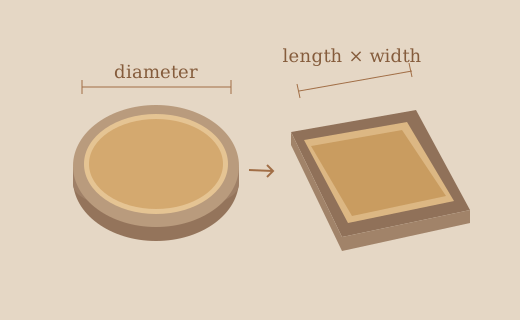
For this calculation, use the inside bottom dimensions rather than the handles or outer rim. A rectangular pan’s area is length × width. A round pan’s area is π × (diameter ÷ 2)². An 8 in round pan has about 50.27 in² of bottom area; a 9 × 9 in square has 81 in².
King Arthur’s pan-size reference uses bottom area to compare standard pans. Our calculator shows the geometry directly and keeps pan count explicit. It supports only round and rectangular bottoms, not shaped pans, tube pans, Bundt pans or irregular cavities.
Calculate the factor, including pan count
Divide the target total area by the original total area. Replacing one 8 in round pan with one 9 in round pan gives 63.62 ÷ 50.27 = 1.265625. A recipe quantity factor of roughly 1.27 would keep the same theoretical layer depth if other conditions were equal.
If the original recipe uses two 8 in rounds, multiply the original area by two before comparing. A 9 × 13 in target is 117 in², compared with about 100.53 in² for the two rounds. The area factor is about 1.16, not 2.33. Forgetting the number of pans can create a much larger error than rounding π.
Keep units consistent
Inches and centimeters describe the same physical pan, but their numerical areas differ. Convert each length using 1 in = 2.54 cm before calculating square centimeters. Do not convert an area by multiplying by 2.54 once; the area factor is 2.54².
The calculator converts the existing dimensions when you change units, so the recipe factor should remain the same. Changing from an 8 in pan to an 8 cm pan is a different project, not a unit switch.
Target area and original area both acquire the same unit-conversion factor. It cancels when one is divided by the other.
Area is not a baking-time calculator
The comparison assumes a similar intended batter depth. It does not check the pan’s actual depth, usable fill, taper, material, heat transfer or the recipe’s rise. A deeper pan does not automatically make an area-based substitution suitable.
Keep the original recipe’s instructions and the pan manufacturer’s guidance. The displayed factor is an ingredient-quantity planning aid, not an assurance against overflow or a recommendation for time and temperature. For a pan outside this tool’s geometry, use a recipe or method designed for that pan.
References & further reading
These references support the ingredient and pan context. The worked numbers and diagrams above are our own explanatory examples.