Choose the denominator before dividing
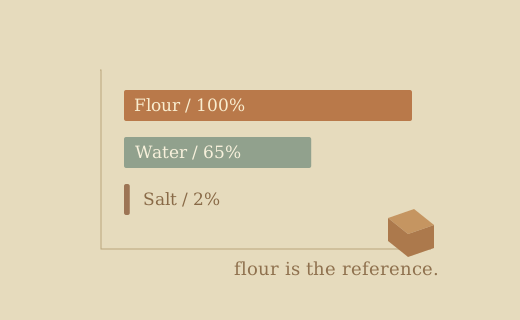
An ordinary share of a total uses the whole total as its denominator. Baker’s percentages use the total flour mass instead. An ingredient’s baker’s percentage is its mass ÷ flour mass × 100. The flour is therefore 100%, whether the batch contains 100 g or 10 kg of flour.
If a formula contains several flours, their combined mass is the flour basis. This first calculator accepts one combined flour weight rather than tracking flour blends. The output describes the formula you enter; it does not recommend an ingredient percentage.
A complete 500 g flour example
Enter 500 g flour, water at 65%, salt at 2% and yeast at 1%. The calculated water is 500 × 0.65 = 325 g. Salt is 10 g and yeast is 5 g. The combined ingredient mass is 840 g.
The percentages add to 100 + 65 + 2 + 1 = 168%. Water is 65% of the flour mass, but only 325 ÷ 840 × 100 = about 38.69% of the full ingredient mass. These are different descriptions with different denominators.
There is no requirement for baker’s percentages to total 100%. The extra percentages describe ingredients added to the flour basis.
Add ingredients without changing the flour basis
The tool also has sugar and oil/fat fields. If sugar is 10% and oil/fat is 5% in the same 500 g flour example, their masses are 50 g and 25 g. The formula becomes 183% and the combined ingredient mass becomes 915 g.
Those optional fields are ingredient categories for arithmetic. They do not model the water contained inside butter, milk, eggs or syrups. Naming an ingredient “fat” does not establish its composition. Keep ingredient composition separate from a straightforward percentage-of-flour calculation.
Know what happens with preferments
A preferment can contain both flour and water. A formula that lists it as one separate ingredient may not show the overall flour and water percentages. King Arthur’s professional reference explains the distinction between a preferment as one line and an overall formula.
This version does not decompose starters or preferments. If your purpose is an overall formula, account for their constituent flour and water in your own formulation before using a combined flour basis. The tool does not calculate fermentation schedules or make performance claims about a dough.
References & further reading
These references support the ingredient and pan context. The worked numbers and diagrams above are our own explanatory examples.